
Stocks Max Pain: What It Tells You and When It's Noise
What max pain measures, how to compute it from open interest, and the dealer-gamma conditions that make the level worth reading instead of noise.
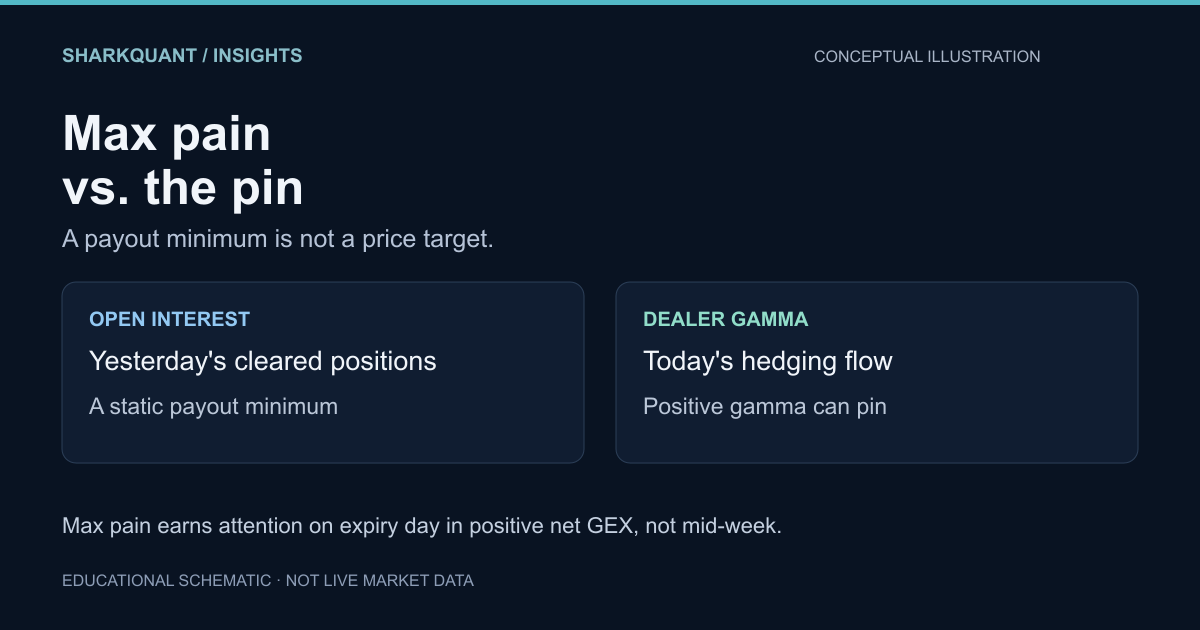
Max pain is the strike where option buyers collectively lose the most at expiry, computed from open interest. For SPY and QQQ expiration weeks, it is worth a glance next to your net GEX read. For a thin single name, mid-week, or after a catalyst, it is noise, and dealer gamma positioning tells you which case you are in.
What does max pain mean in stocks and options?
Max pain is the strike where option writers lose the least: the strike with the minimum combined intrinsic value of all outstanding calls and puts. Compute it across every listed strike and the one with the lowest total payout to holders is the max pain level.
The "pain" belongs to the writers. Because dealers and market makers hold the bulk of short open interest, the level is read as where dealer positioning would prefer price to settle at expiration. The calculation rests on open interest, which clears once a day, so any intraday max pain read is working from yesterday's positioning plus same-day volume. That lag matters most on 0DTE, where the contracts expiring today are the ones trading, and where OI-based levels can be overtaken within hours.
How is max pain calculated from open interest?
For each strike, sum the intrinsic value owed to every call and put holder across all open contracts, then pick the strike with the smallest total dollar payout. That strike is max pain. The calculation is deterministic: same open-interest table, same answer every time.
Worked example on a small open-interest table
Say SPY has three strikes with open interest, all expiring Friday, with spot at 598. Payout per contract is $100 per point of intrinsic value; the totals below are in points, so multiply by 100 for dollars.
- 595: 2,000 calls are 3 points in the money, the 500 puts are out of the money, so the payout is 6,000 points.
- 598: every contract is at the money, so the payout is 0.
- 600: the calls are out of the money, and 2,000 puts are 2 points in the money, so the payout is 4,000 points.
Max pain here is 598, the strike that minimizes seller pain. Real tables run hundreds of strikes and several expiries, which is why tools do this for you. For how the same open-interest structure behaves in SPX and SPY same-day contracts, see SPX vs. SPY 0DTE options.
Common calculation variants and their pitfalls
Aggregation choice matters more than the formula. Weekly-only open interest isolates the Friday pin; all-expiry open interest blends months together and can place max pain hundreds of points from anything relevant this week. On 0DTE names, the count only reflects positions opened before the snapshot, so an intraday max pain print lags the live book.
Two staleness traps are worth naming. Open interest updates once a day, after trades clear, so any intraday "recalculation" is using yesterday's positioning. And payout math assumes $100 per point per contract, so tools that substitute midpoint marks distort the answer on wide spreads or deep in-the-money strikes. If a display shows max pain moving mid-session, it is re-deriving from old open interest, not reacting to new positioning. The open-interest guide covers why that count and traded volume answer different questions.
Why does SPY max pain get so much attention on expiration week?
Expiry week is when the two ingredients for actual pinning line up: enormous open interest concentrated at round strikes, and dealer hedging flows large enough to move price toward those strikes. Off expiry week, max pain is just a number. On expiry Friday, it is a level dealers may be mechanically defending.
0DTE volume and same-day expiries
Cboe reports that 0DTE contracts account for 59% of SPX volume, which means a large share of an index chain's expiry-day gamma expires within hours. Dealers hedging that same-day gamma trade in the direction that keeps their book delta-neutral, and with net GEX positive, that hedging dampens movement between high-open-interest strikes. That is why the call wall and put wall, not max pain alone, are the levels worth watching, and why vanna and charm add a second layer near expiry.
Pinning versus coincidence
Academic work on the effect, such as Avellaneda and Lipkin's market-induced mechanism for stock pinning, treats pinning as a real equilibrium when dealers are long gamma rather than folklore. It is regime-dependent: when net GEX flips negative or volatility spikes, the pin dissolves. Check dealer positioning first, then decide whether max pain matters today.
Does price actually gravitate to max pain — and when does it not?
The honest answer is sometimes, under narrow conditions. The gravitation claim holds up best when dealers sit long gamma on expiration day and hedging flows mechanically push price toward the strike with the largest open interest. Outside that window, max pain is a descriptive statistic, not a forecast.
Conditions where the level has teeth
Max pain is most credible on expiration day, in a high-GEX regime where net dealer gamma is positive and the underlying has no fresh catalyst. In that setup dealers hedge by buying dips and selling rips, and the strike with the heaviest open interest acts like a magnet into the close. Pinning on SPY and SPX expiry Fridays is the classic case, and the mechanics are the ones broken down in why price pins to a strike. Mid-week, the same level carries far less weight because less time pressure is forcing hedges to converge.
Conditions where it is noise
The claim fails in three common situations. First, trending sessions: when macro news or a gap has set a direction, hedging flows amplify the move instead of suppressing it. Second, negative net GEX regimes, where dealers are short gamma and hedge by chasing price, which produces volatility rather than pinning. Third, after a news shock, when fresh positioning overwhelms stale open interest.
The practical takeaway: check net GEX and dealer positioning before you treat max pain as a level. If dealers are long gamma and the session is quiet on expiry day, respect it. If net gamma is negative or a catalyst just hit, the level is a coin flip, and the gamma flip point says more about where hedging behavior changes than the pain print does.
How does max pain differ from the gamma flip level?
Max pain is static. It is the strike where option holders collectively collect the least, computed from open interest that updates once a day after trades clear. It answers one question: where does the expiry payout curve bottom out, given yesterday's positioning?
The gamma flip is dynamic. It marks the net dealer gamma boundary where hedging shifts from buying dips and selling rips, which pins price, to chasing moves, which amplifies them. It moves intraday as contracts trade and expire, and it answers a different question: is dealer hedging dampening or accelerating price right now? Reading the gamma flip covers how that level is estimated.
The two often sit far apart. SPY can have max pain at 590 while net GEX flips at 595, and the flip is the level governing intraday behavior; max pain only earns its reputation when price is already pinned near it in positive gamma during expiration week. Treat max pain as a static expiry anchor and the flip as the regime switch, then read both against skew.
How should you read max pain for a high-volatility single name like HIMS?
On a single name with thin open interest, max pain is mostly narrative bait. The count is small enough that one large position can move the strike with the highest total dollar pain from one day to the next. Wider bid-ask spreads mean dealers hedge coarsely, and event-driven gaps override whatever the open-interest distribution implied at the prior close.
The test is the same one you would apply to SPY, just with stricter thresholds: check whether net GEX is meaningfully positive, and whether the max pain strike holds real open interest or a few hundred contracts. Dealer-positioning frameworks such as the ones SpotGamma documents assume liquid underlyings with dense strikes. A thin name has neither, so the gamma flip level carries little pinning force either.
The practical rule: expiration-week max pain on SPY or SPX is a level worth respecting. Mid-week max pain on a low-open-interest, high-IV name is a story people tell after the close. If your GEX map shows sparse strikes and choppy net GEX, skip the max pain read and trade the flow instead.
How can you use max pain without falling for the manipulation narrative?
The pinning story is hedging mechanics, not a conspiracy. Dealers are long or short gamma depending on positioning; when they are long gamma, their hedging sells rallies and buys dips, which dampens movement toward expiry. Max pain matters when that positioning is large and concentrated near the strike, and it is noise when positioning is thin or the name is running on flow rather than hedging.
A pre-trade checklist for expiry-day reads
Run this before acting on a max pain level:
- Net GEX regime. Positive net GEX means hedging suppresses volatility; negative means dealers chase moves and max pain loses its pull.
- Walls. A call wall or put wall near max pain gives the level real hedging mass behind it. A max pain strike with no wall is just arithmetic.
- Distance and time. Mid-week, or roughly 1% away on SPY, treat it as background. Expiry Friday in a high-GEX regime is when it earns attention.
- Invalidation. Define the condition that kills the read: a sweep through the wall, a gamma flip, or a macro print. If price breaks the wall with volume, the level is dead and you are in a chase regime.
Every read needs its invalidation before entry, not after.
FAQ
Is max pain the same as the pin strike on expiration day?
Often close, but not by definition. Max pain is the strike minimizing total payout to option holders, while the pin is where dealer hedging actually holds price into the close. The two coincide when a call or put wall sits near max pain and net GEX is positive on expiry Friday. Otherwise they can sit far apart.
What time do max pain levels get recalculated, and does stale open interest matter for 0DTE?
Open interest updates once daily, after trades are reported and cleared, so intraday max pain prints re-derive from yesterday's positioning. For 0DTE, where Cboe puts same-day contracts at 59% of SPX volume, that staleness is severe: the level can lag the live book badly and is best treated as background, not a tradeable number. The open-interest explainer covers the reporting cycle.
Do market makers actually manipulate stocks to max pain?
No conspiracy is required. When dealers sit long gamma near expiry, their hedging mechanically sells rips and buys dips, which can nudge price toward heavy open-interest strikes. That looks like pinning but is delta-neutral risk management. When gamma is negative or a catalyst hits, the same hedging amplifies moves and max pain loses its pull entirely.
Can max pain work on ETF options like QQQ the same way as single stocks?
Yes, and often better. QQQ has dense strikes, heavy open interest, and active dealer hedging, the same conditions that make SPY expiration-week reads credible. The same rules apply: check net GEX, look for a wall near the level, and only respect it on expiry day in a positive-gamma regime. Thin single names behave far less predictably.
Educational analysis of market structure, not investment advice. Levels and regimes change; verify the current chain before acting.