
Open interest vs. options volume: what they tell you
Options volume and open interest answer different questions about an option chain. Here is what each number tells you, and what neither can reveal.
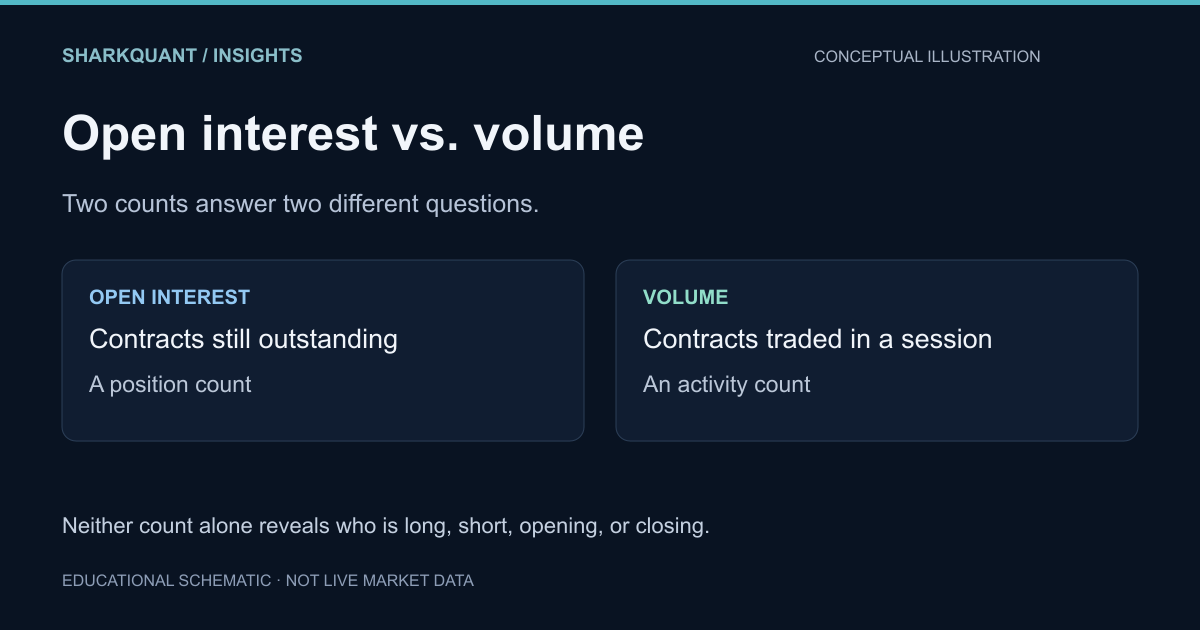
Many option chains show volume and open interest beside each contract. Volume records activity within a session. Open interest counts the contracts that remain outstanding after clearing. Treating those numbers as interchangeable can turn an active trading day into an unsupported story about new positions.
Options volume is the number of contracts traded during a session. Open interest is the number of contracts still open after that session is processed. Volume captures activity; open interest captures standing positions. The OIC puts it directly: volume measures activity within a session, while open interest reflects the cumulative number of contracts still open (Options Industry Council).
Where each number comes from
Open interest is not computed by your broker or by individual exchanges. The Options Clearing Corporation consolidates the exchanges' trade reports, applies the day's opening and closing transactions, and removes contracts that were exercised or assigned, since those no longer exist as positions (OIC). The result is a once-a-day count. Intraday, the open interest on your screen reflects the previous session, not the trades in front of you.
Volume is faster and simpler: it counts contracts that changed hands during the session, no matter what happens to those positions afterward.
One trade, three arithmetic outcomes
The arithmetic connecting trading to open interest is easiest to see with a hypothetical example.
Imagine two hypothetical traders. One buys to open ten contracts, and the other sells to open those same ten. The trade prints ten contracts of volume, and open interest rises by ten, because the contracts now exist as positions.
Later, the same two traders trade against each other to close. Another ten contracts print as volume, and open interest falls by ten.
Now change one side. One trader closes ten while a third trader opens ten against them. Volume still prints, but open interest does not move. The contract simply changed hands. The OIC documents the same three combinations: both sides opening raises open interest, both sides closing lowers it, and one opening against one closing leaves it flat.
So the same volume can leave open interest higher, lower, or unchanged. Volume measures activity. Open interest measures the net creation or cancellation of positions.
What each number can tell you
Volume is an activity gauge. It identifies contracts that traded during the session and helps place an unusual print in context (Options flow vs. dealer positioning). Heavy volume does not guarantee a tight spread or enough displayed size for your next order. A large earlier block can coexist with poor liquidity now.
Open interest is a standing-position count, not the size of an executable order book. It helps identify strikes and expirations with many outstanding contracts. Weighted by Greeks and a position-sign assumption, it becomes an input to exposure estimates (How to read a GEX heatmap). A high count alone cannot prove that a strike will hold at expiration.
Neither number reveals ownership, and this is the point most worth internalizing:
- Open interest counts contracts, not people. Every contract has a buyer and a seller, and the count is identical whether one participant is on both sides of a crowded trade or thousands hold small positions.
- Open interest does not label dealers. Commentary that says "dealers are short these puts" comes from transaction-level inference, not from open interest. The GEX researchers at SqueezeMetrics state that publicly reported open interest only tells you the number of contracts in existence on a given day, which is why estimating dealer direction requires per-trade analysis.
- Public data does not identify participants. The OIC notes that public options data identifies the product, size, strike, and expiration of trades, but not whether the participant is retail or institutional. Data that cannot separate retail from institutional certainly cannot separate hedger from speculator.
What changes in open interest do and do not mean
You will run into rules of thumb like "rising open interest plus rising price means new longs," or "falling open interest in a rally means short covering." The mechanics do not support those shortcuts on their own. An opening trade creates a long and a short at the same moment, and open interest cannot see which side was initiated, which side is hedged, or which side intends to hold. A rising count is consistent with several participant stories, and the count alone does not choose among them.
What open interest changes do show is structural: positions were created or destroyed. That matters for expiration mechanics, for liquidity expectations, and for how much size can be affected by assignment. It does not identify motive.
A practical checklist
- Use volume to find activity and open interest to find standing positions. Check current quotes to judge tradability.
- Compare the two. A strike trading several times its open interest is seeing heavy turnover; high open interest with light volume is standing positioning that simply has not moved.
- When comparing open interest day over day, compare like with like. It updates after the close, so read it as of the prior session.
- On expiration week, read both measures with their timestamps. Overnight open interest cannot capture all same-day position changes, and expiry processing changes the count (0DTE and the gamma landscape).
- Before acting on any "surge," check the spread and liquidity, not just the counts (Options liquidity and the bid-ask spread).
Limits worth remembering
- Open interest is a lagging, aggregate count with no side and no identity attached.
- Volume includes buyers and sellers of both calls and puts, and it says nothing about which participants are hedging. The SEC's options investor bulletin describes the same four participant types.
- Neither number speaks to intent, or to whether offsetting exposure exists elsewhere.
- Anything that converts open interest into "dealer positioning," including GEX, is a model estimate, not reported dealer inventory.
Read together and read honestly, the two numbers answer two clean questions: what traded today, and what remains open. They do not answer who did it or why.
Sources and further reading
- Options Industry Council, Open Interest: Why It Matters
- Options Industry Council, May Office Hours FAQs
- SqueezeMetrics, The Implied Order Book
- SEC, Investor Bulletin: An Introduction to Options
Educational content only. This is not personalized investment advice and not a recommendation to buy or sell any security. Options involve risk and are not suitable for every investor.
Prepared with AI assistance; reference links were checked before publication.