
Why Price Pins to a Strike on Expiration Day
Pinning is a hedging effect, not a law of markets. What actually holds price near a strike into the close, how to spot a pin candidate, and how pin risk turns into an unwanted stock position.
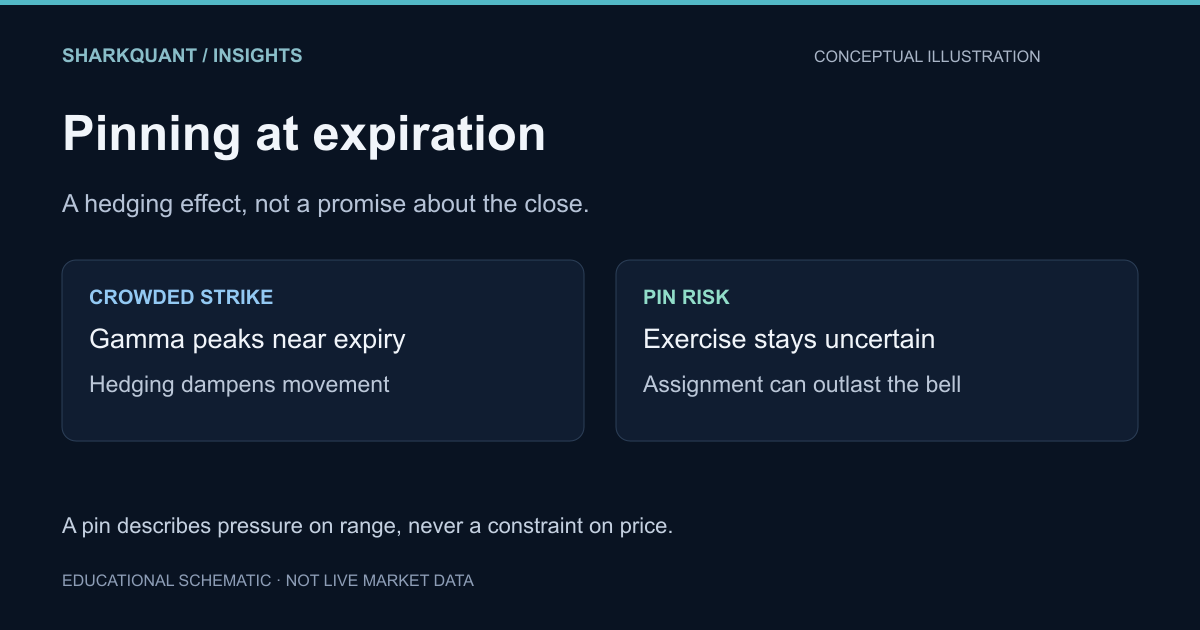
Traders talk about pinning as if the market owes them a close at a round strike. It does not. Pinning is the visible result of a hedging process, and it holds only while the conditions that produce it hold. Understanding the mechanism tells you when to lean on it and, more importantly, when to get out of the way.
What pinning actually is
Pinning describes a tendency for an underlying to close near a strike that carries heavy open interest at expiration. The strike becomes a magnet not because anyone wants it there, but because the options expiring at that strike change the hedging behavior of the firms carrying the other side.
A short-dated option sitting at the money has the highest gamma it will ever have. Its delta flips quickly as price moves, so a hedger who is short that option has to buy when price falls and sell when it rises to stay neutral. That is stabilizing flow: it pushes against the move instead of with it. When a large block of open interest sits at one strike and price is close to it, that stabilizing flow concentrates, and realized movement compresses.
The effect is strongest when three things are true at once:
- A strike near spot carries unusually large open interest or gamma.
- Expiration is imminent, so the gamma of those contracts is at its peak.
- The session is quiet, so the hedging flow is not competing with a larger directional force.
Remove any one of those and the pin weakens. Macro releases, index rebalances, a broad liquidation, or a single large directional trader can override the dampening flow entirely. A pin is a description of pressure, not a constraint on price.
Why the close matters more than the level
The interesting part of pinning is not the intraday drift toward the strike. It is that expiration converts an option position into something else at the close.
An option that finishes in the money is generally exercised automatically, subject to the threshold set by clearing-house rule and your broker's own handling. That threshold has changed over time, so the exact boundary is worth checking in the current rulebook rather than assuming last year's number. What matters practically is this: a short option that finishes barely in the money becomes an assignment, and an assignment delivered over a weekend becomes a stock position you did not plan to own. The market is closed when you find out.
That is pin risk. It is not the risk that price moves against you. It is the risk that you do not know whether you have a stock position until after you can no longer trade the option.
Spotting a pin candidate without over-committing
A defensible pin read starts with the chain, not with a chart pattern:
- Rank strikes by open interest and by estimated gamma for the expiring series only.
- Check how far the largest concentration sits from spot, in units of the expected move for the session.
- Confirm the strikes are liquid enough that the open interest is real inventory rather than stale positioning nobody will trade.
- Look at the share of total volume in same-day expiries. Heavier same-day participation means the mechanical layer is a larger fraction of the tape.
Then set the conditions under which you would abandon the idea. If the read is "price stays within a band around 5,900 into the close," the invalidation is a break of that band with volume, not a feeling that the pin "should" hold. This is the same discipline described in why every SharkQuant read names its invalidations: a level that cannot be wrong is not a level.
Two limits are worth stating plainly. First, estimated gamma depends on an assumption about who is long and who is short, so the concentration you see is a model output, not observed inventory. The gamma exposure explainer covers that assumption in detail. Second, a wall is a broader idea than a pin. A wall can persist for weeks; a pin exists for hours and only at expiration.
Handling the last hour
If you are short options into the close, the decision is not about being right on direction. It is about whether you want the assignment.
- Closing the short before the bell removes the uncertainty and usually costs you the remaining extrinsic value, which is exactly what you should expect to pay for certainty.
- Holding through the close means accepting the possibility of an overnight stock position, funding requirements, and gap risk on the next open.
- Letting a position sit because it is "only a few cents in the money" treats a binary outcome as if it were small. The premium is small. The stock position is not.
Most account damage from expiration does not come from a wrong market opinion. It comes from a position whose economic exposure changed after the point where it could still be managed.
Bottom line
Pinning is what hedging looks like when a strike is crowded and time is short. Treat it as a probabilistic squeeze on range, size it as such, and resolve assignment risk deliberately rather than discovering it on Monday morning. The strike is not a magnet. It is a crowd, and crowds disperse.