
Theta and the Cost of Time in Options
Time decay is not a straight line and not an income stream. How theta is defined, why it accelerates into expiration, and how it trades off against the gamma you are carrying.
Every option premium contains two kinds of value: intrinsic value, which is what exercising now would be worth, and extrinsic value, which is what the market pays for the possibility of more. Theta is the rate at which that second part erodes as time passes. It is the most quoted and least understood number on an options chain.
What theta measures
Theta is the sensitivity of an option's price to the passage of one day, holding the underlying price, implied volatility, and all else constant. On a chain it usually appears as a negative number for long options and a positive number for short ones, quoted per share or per contract depending on the platform.
Two things follow from that definition, and both matter.
First, theta is a local derivative, not a forecast. It reports the current rate of decay. It does not tell you what the option will be worth tomorrow, because nothing else is ever held constant: the underlying moves, implied volatility reprices, and theta itself changes as the option ages.
Second, the "all else constant" clause is doing heavy lifting. An option can lose value from theta and gain far more from a move in the underlying on the same day. Quoting theta as if it were a daily cost you are guaranteed to pay is only accurate for a position that does not move.
Decay is not linear
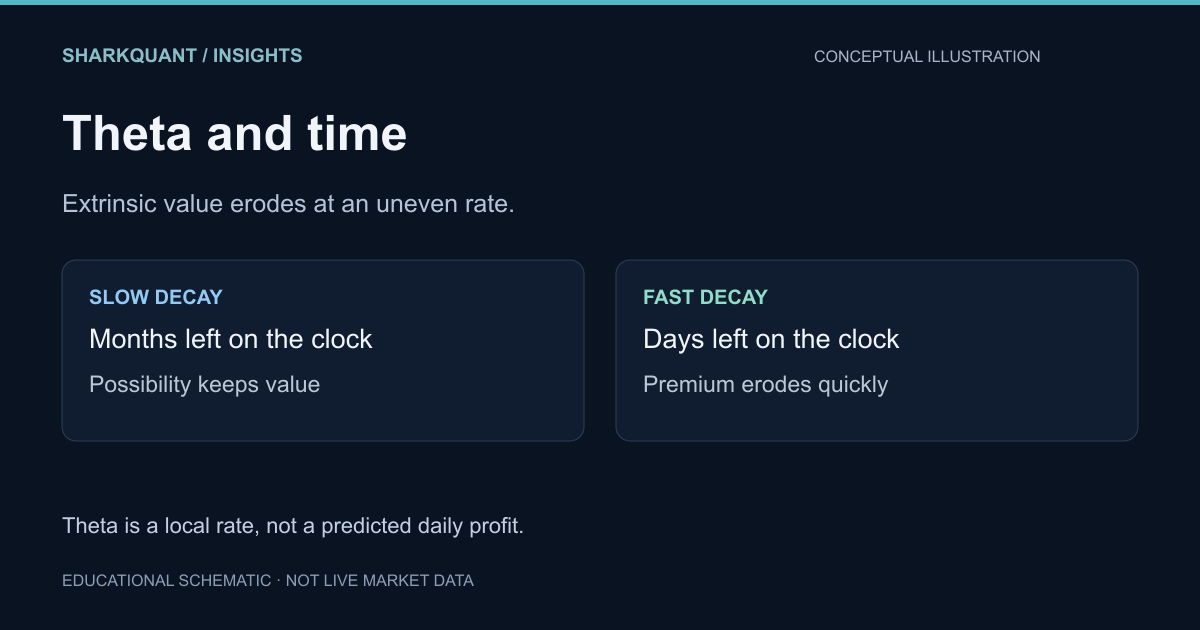
Extrinsic value decays slowly when there is a lot of time left and quickly when there is not. The intuition: with months remaining, a move that puts the option in the money is still plausible, so the possibility retains most of its value. With three days remaining, the same distance from the strike has far less opportunity to be covered, and the market prices that reality quickly.
This is why a one-week option does not lose one-fifty-second of its value each week, and why a same-day contract can lose most of its premium in the final hours. For at-the-money options the curve is steepest right before expiration.
The shape has a practical consequence for expiry selection. If your thesis needs five days to play out and you buy a seven-day option, you are paying for two days of runway you will spend at the steepest part of the decay curve. Longer-dated contracts cost more in absolute premium but decay more slowly per unit of time. Neither is better in the abstract; the choice depends on how long the thesis needs.
Theta and gamma are one trade
You cannot discuss theta honestly without gamma, because they are two sides of the same position.
An at-the-money option near expiration has high gamma and high theta in absolute terms. Its delta changes fast, which is why it can pay off quickly, and its remaining time is short, which is why it decays fast. Buying it is buying convexity and paying heavily for it. Selling it is collecting that decay while being short the convexity, which means the loss distribution is the mirror image: many small wins, occasional sharp losses.
This is the same asymmetry that explains the variance risk premium discussed in the implied vs realized volatility guide. Theta income is not a yield. It is payment for carrying risk that arrives in bursts.
The trade-off also shows up in the second-order Greeks. A position with strong positive theta usually has an exposure to implied volatility changes that it did not intend, and the wings of the surface can reprice in ways that swamp a week of collected decay. The vanna and charm guide covers how delta itself drifts with volatility and time.
Where the number misleads
Three specific traps:
- Annualizing short-dated theta. A one-day option with dramatic daily theta does not imply a repeatable annual return. There is no year of that trade; there is a day of it, and it either works or it does not.
- Ignoring the underlying. Theta assumes a static spot. A position that is short theta and long a directional view is really a directional trade with an expiry date, and the expiry is the risk control, not the income.
- Treating decay as certain and assignment as unlikely. Expiration converts option risk into other risk. The mechanics of what happens when a short option finishes near its strike are covered in the pinning guide, and they are not a footnote.
Sizing the time cost
A practical check uses relativity rather than absolutes:
- Express theta as a fraction of the option's current premium, so a 0.05 theta on a 6.00 contract reads as under one percent per day and a 0.05 theta on a 0.40 contract reads as twelve percent.
- Compare that fraction against the move you need. If the thesis requires a two percent underlying move and the premium is bleeding twelve percent a day, the arithmetic is against you unless the move is fast.
- Note the scheduled events inside the option's life. Implied volatility is highest before known events and drops after them, so a position bought before a catalyst pays both decay and repricing. That interaction is explained in the IV crush guide.
- Check the invalidation before entry. A time stop is a legitimate exit condition, and writing it down in advance prevents the drift where a decaying trade becomes a long-term hold.
Bottom line
Theta is the price of optionality, quoted as a rate. It accelerates into expiration, it is inseparable from the gamma you carry, and it is not income. Used as a relativity check against premium and against the move you actually need, it is one of the cleanest sanity tests in options trading. Used as a headline yield, it is how accounts get slowly and then suddenly smaller.