
Vanna and charm explained: delta beyond price moves
Vanna and charm shift an option's delta even when price stands still. What these second-order Greeks measure, and why hedgers cannot ignore them.
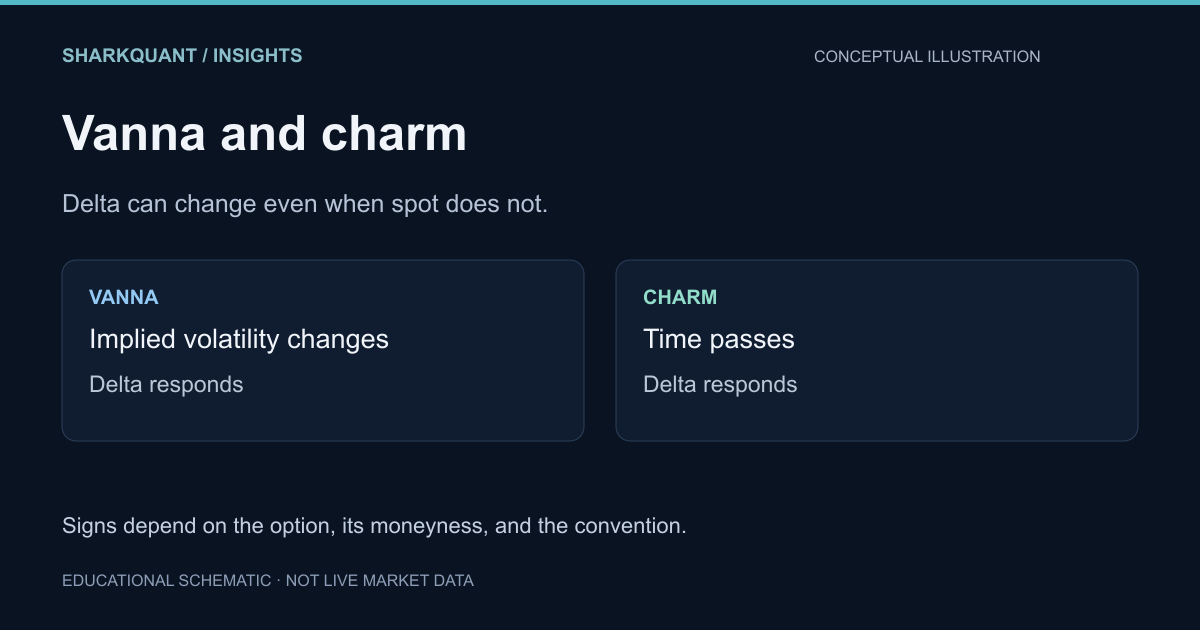
A delta hedge sounds like a finished job. Match the position's delta with an offsetting amount of stock, and the book is neutral. Then it stops being neutral, because delta is not a constant. It moves when implied volatility changes, and it moves as the calendar advances, even on a day when the underlying does not budge. Vanna and charm are the names for those two drifts.
Vanna measures how much an option's delta changes when implied volatility changes. Charm measures how much delta changes as time passes. Both are second-order Greeks, sensitivities of a sensitivity (Macroption). For anyone trying to understand dealer re-hedging flow, they answer a question that gamma alone cannot: why hedges move when price does not.
Vanna: delta's exposure to volatility
Vanna is the cross-sensitivity of an option's value to spot price and implied volatility. It is the change in delta per change in volatility, and by the symmetry of second derivatives it is also the change in vega per change in spot price (Macroption lists both forms). Units depend on convention. Vega is often quoted per one percentage point of volatility rather than per full volatility unit, so vanna values from different sources can differ by a factor of 100. Check which convention a number uses before comparing it with anything.
For a common near-term intuition, rising implied volatility can move out-of-the-money deltas toward the middle of their range and in-the-money deltas away from their extremes (OIC office hours FAQ). Put deltas are signed negative, so a '50 delta' put usually means a magnitude of 0.50, or a signed delta near -0.50. This is a useful local description, not a universal sign rule for every maturity, carry assumption, or volatility level.
Consider a hypothetical dealer long a standard out-of-the-money put with a delta of -0.20. With a 100-share multiplier, that is about -20 shares of delta, offset by 20 long shares. Assume a modest fall in implied volatility changes the modeled put delta to -0.17 while spot and the other inputs remain fixed. The put now carries about -17 shares of delta, so selling three hedge shares restores neutrality. The delta values are invented to illustrate the mechanism. A different option or net portfolio can require the opposite adjustment.
Around an earnings release, implied volatility can fall across a near-dated chain and change deltas in addition to changing premiums (Earnings IV crush explained). Whether the resulting hedge adjustment involves buying or selling depends on the positions and their signed vanna. It cannot be inferred from a falling IV number alone.
Charm: delta decay as the clock runs
Charm is the change in delta per unit of time, which is why it is sometimes called delta decay (OIC FAQ). As expiration approaches, delta does not sit still: the delta of an in-the-money option drifts toward 1 (or negative 1 for puts) and the delta of an out-of-the-money option drifts toward 0, because less time remains for the outcome to change (OIC, Gamma).
Conventions matter for the sign. If time means time remaining until expiration, charm in the standard formulas carries one sign; if it means calendar time moving forward, the sign flips. Moneyness matters too: the drift runs one way for strikes in the money and the other way for strikes out of the money. A charm number without its convention and its strikes is not meaningful.
A hedged book can lose neutrality as the clock runs even in a flat tape. The OIC describes this drift without requiring a trader to label it as charm. Close to expiration, delta can change sharply, but 'closer means larger charm' is not a universal rule across all strikes. Contract moneyness, carry, and the shape of the pricing model matter (0DTE and the gamma landscape).
For a second hypothetical, suppose a dealer owns an in-the-money call with a +0.60 delta and hedges one standard contract with 60 short shares. Assume that, at unchanged spot, its modeled delta rises to +0.80 later in the session as time passes. The dealer would sell 20 more shares to restore the hedge. A dealer short the same call would need the opposite adjustment. The assumed deltas are teaching inputs, not a prediction that every near-money call follows this path.
Reading vanna and charm in practice
- Learn the conventions first: volatility units for vanna (per point or per percent), and the time convention for charm (calendar time or time to expiration).
- Inspect vanna and charm by strike and expiry. Do not assume they share gamma's near-the-money peak; their signs and magnitudes have different shapes.
- Around scheduled volatility events, examine vanna alongside the expected IV change. Around expiration, examine charm alongside the remaining time. Net portfolio exposures can reinforce or offset one another; a large gamma concentration alone does not tell you the direction (Reading the gamma flip).
- Treat both as context, not signals. They describe a conditional mechanical bias in hedging, not a direction.
- When a chart or a provider shows vanna or charm exposure, ask what model and what positioning assumptions produced it. Different vendors assume different things.
Limits
- These are model sensitivities. They are well defined inside a pricing framework, but their translation into live flow depends on actual positions and actual hedging behavior.
- Dealer exposure to vanna and charm is inferred, not reported. Public open interest carries no ownership information.
- Magnitudes vary by product and era. SqueezeMetrics concluded in its 2020 paper that charm was too small an effect to have practical utility in its framework. The growth of very short-dated options since then suggests that judgment is worth testing rather than quoting as settled; either way, the size of the effect is an empirical question, not a constant.
- Nothing here guarantees that hedges will be adjusted in any particular window, or that the adjustments will move price. The flow is conditional, like every positioning-derived reading.
The takeaway: delta is a moving target. Vanna explains why volatility changes move it, charm explains why the clock moves it, and conditional hedging is why either can show up in the tape without a price move. The gamma side of the same machinery is covered in Gamma exposure explained.
Sources and further reading
- Options Industry Council, May Office Hours FAQs
- Options Industry Council, Gamma
- Macroption, Second Order Greeks
- SqueezeMetrics, The Implied Order Book
Educational content only. This is not personalized investment advice and not a recommendation to buy or sell any security. Options involve risk and are not suitable for every investor.
Prepared with AI assistance; reference links were checked before publication.