
IV crush after earnings: why the right call can lose
When earnings resolve, implied volatility can fall faster than the stock moves. Why a right call on direction can still lose money, and what to check.
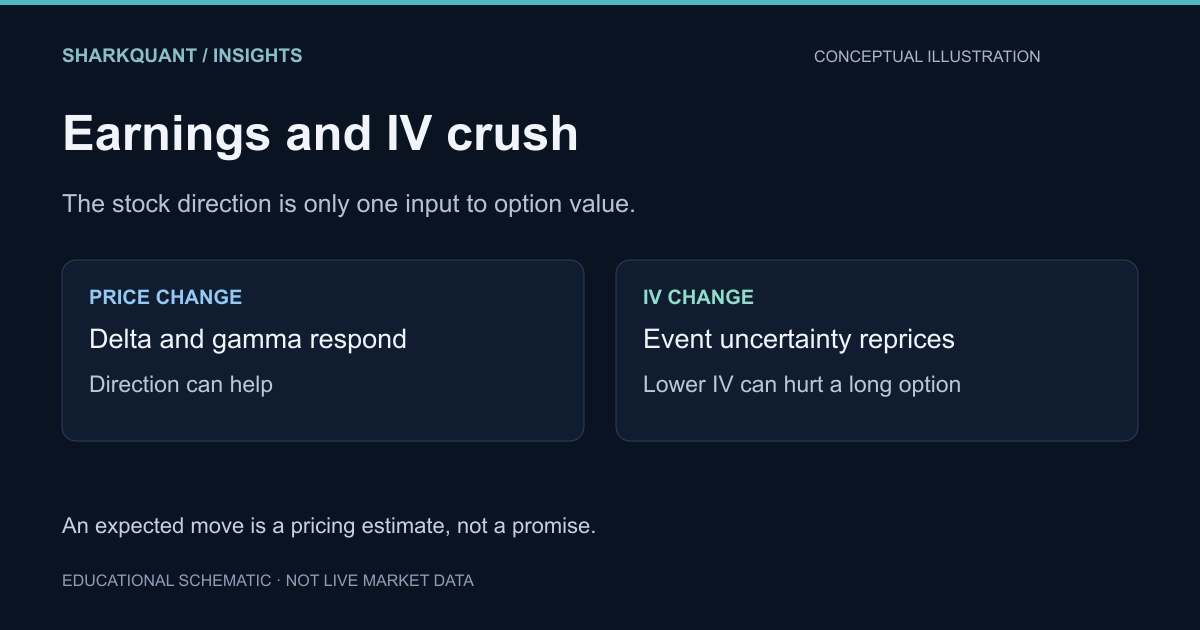
A trader gets the direction right, the stock moves the intended way, and the position still loses money. That is not a market malfunction. It is implied volatility doing what it does around scheduled events, and the shorthand for it is IV crush.
IV crush is the sharp drop in implied volatility that follows a scheduled event such as an earnings report. Because option prices embed the market's expectation of future movement, an event that removes uncertainty can shrink premiums quickly, even when the stock moves the way you expected.
Implied volatility is the price of uncertainty
Standard option pricing models use the same inputs: strike price, stock price, time to expiration, interest rates, dividends, and implied volatility. Implied volatility reflects the market's expectation for how much the stock will move, in either direction, and it is embedded in the option's price. Higher implied volatility means higher option prices; it tends to rise when there is uncertainty or anticipated news, and to fall in calmer stretches.
Heading into an earnings date, that uncertainty builds. Implied volatility typically climbs, options get more expensive, and the premium being paid embeds a forecast of the move the market expects.
Vega is how a volatility change turns into dollars
Vega measures how much an option's premium changes when the implied volatility assumption changes by one percentage point. Longer-dated options usually carry higher vega; short-dated ones carry less. OIC's own example: a 12-month call with a vega of 0.15 would be expected to gain about $0.30 in premium if implied volatility rose 2 points, all else equal.
The phrase to hold onto is all else equal, because it rarely is. Vega itself changes as the stock price and the clock move, and a real repricing happens across the entire option chain rather than one Greek at a time. Vega is a local estimate and a good mental model, not a precise prediction of the next premium you will see.
The example that makes the point
In its July 2026 article The Crush Is Real, OIC gives a teaching example: a $105 call costs $2.90 when the stock is $100 before earnings. The stock rises to $106, but the call is then worth $2.10 after implied volatility falls from 80% to 30%. At the later stock price, the call has $1.00 of intrinsic value. The favorable move is not enough to preserve the original premium. These are OIC's published illustration, not a current quote or a verified trading result.
For a separate hypothetical, buy a standard $102-strike call for $3.00 with the stock at $100. After earnings, assume the stock is $104 and the option is quoted at $2.40: $2.00 intrinsic value plus $0.40 extrinsic value. The contract loses $60 before costs, despite the favorable stock move. Those endpoint prices are invented to illustrate the risk, not produced by a pricing forecast. A vega of 0.04 would imply roughly $4 per contract for a small one-percentage-point IV change, all else equal. Do not multiply that initial vega across a 45-point IV collapse and treat it as an exact loss: vega and the other Greeks change throughout the repricing.
If you want the fuller map of how delta and implied volatility interact, the vanna and charm explainer covers the cross effects.
What the market already paid for
A premium also reflects movement already priced into the option. A common event shortcut is the at-the-money straddle premium divided by spot. A hypothetical $6 straddle on a $100 stock corresponds to a rough 6% move estimate. Use the expiration covering the event. That premium includes the remaining time to expiry, not just the earnings announcement, and the shortcut is neither a guaranteed range nor automatically a one-standard-deviation forecast.
That estimate is not a fixed number to set and forget. As the event gets closer, implied volatility often rises, which pushes the straddle price and the expected move higher. The practical consequence is simple: buying premium into earnings buys the expectation, not a guarantee. A trade can be right on direction and still lose if the move is smaller than what was already priced, and the crush usually compounds it.
What tends to happen after the event
Once results are public, implied volatility often drops sharply, which is the vol crush itself. The effect can offset some or all of the gain from being right on direction, and it is worth saying: this is supply and demand working as designed, not a flaw. Once uncertainty is replaced with more certainty, options reprice.
Two honest caveats. Volatility does not always cool after an event; a surprise can leave it elevated or push it higher. And the other side of the trade is not free money either. Sellers collect that inflated premium going in, but short options carry large risk, and OIC notes that an uncovered writer may face unlimited risk. The crush is a repricing, not a gift to one side of the market.
Checklist before any earnings trade
- Check implied volatility against its own history. IV rank and IV percentile place today's level in context, which helps separate cheap from expensive.
- Price the expected move from the at-the-money straddle and write the number down before entry. Compare it with your scenario.
- Estimate how much of your premium is extrinsic value. The more of it there is, the more the position depends on volatility staying high.
- Ask whether the thesis needs direction alone, or direction plus persistence and timing.
- Compare expirations deliberately. Shorter-dated options cost less but carry a different mix of vega and time decay.
- Name your invalidation before entry, the same discipline described in why every read names invalidations.
Limitations
Every number in this article is illustrative. The OIC example is theirs as published; the vega arithmetic is a textbook style sketch with rounded figures. Pricing models approximate, implied volatility can move in either direction, and a calm earnings reaction is not guaranteed any more than a violent one is. If you are new to the building blocks, start with the Learn section. Educational content only; nothing here is investment advice.
Sources and further reading
- OIC, The Crush Is Real
- OIC, Vega
- OIC, July Office Hours FAQs: Implied Volatility, Position Greeks and Market Maker Order Flow
- OIC, August Office Hours FAQs: Straddles Strategy, Spreads and Managing Risk
- OIC, Leverage and Risk
- OIC, General Information FAQ
- OCC, Characteristics and Risks of Standardized Options
Educational content only. Nothing here is investment advice or a personalized recommendation. Options involve risk and are not suitable for all investors, and you should review the Characteristics and Risks of Standardized Options before trading. Prepared with AI assistance; reference links were checked before publication.