
SPX vs. SPY 0DTE options: settlement and risk
Compare SPX and SPY 0DTE options by settlement, exercise style, contract size, and assignment risk. Know what can happen when the expiration clock runs out.
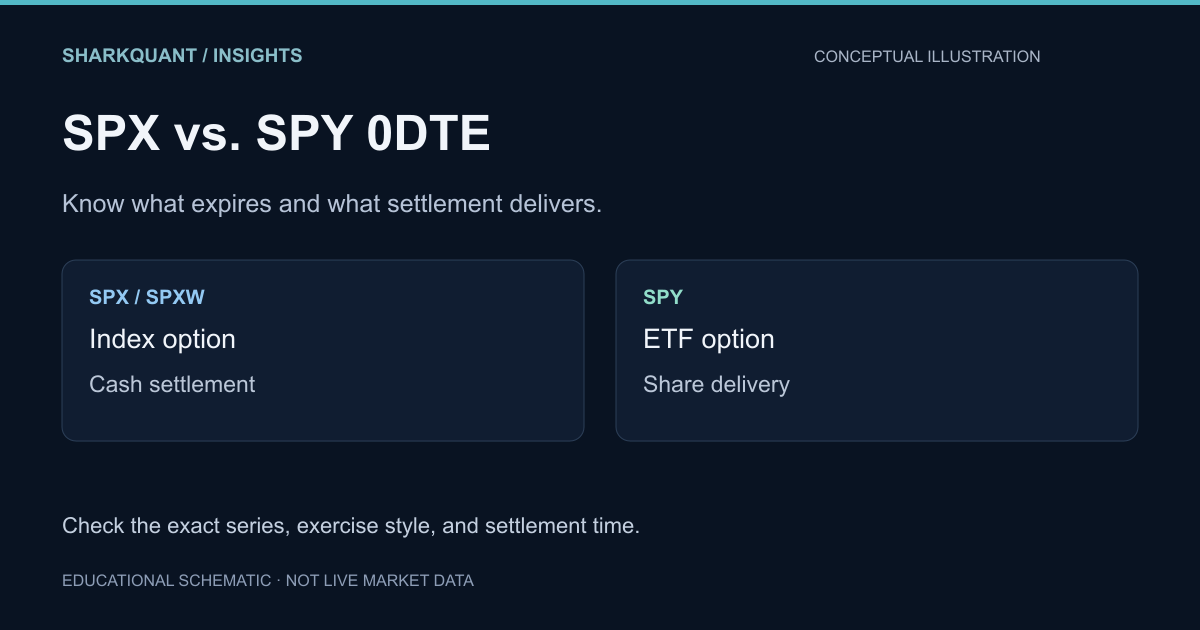
A same-day SPX option and a same-day SPY option can sit next to each other on a watchlist and look interchangeable. They are not.
SPX options are cash settled index options on the S&P 500 Index. SPY options are ETF options on the SPDR S&P 500 ETF Trust that settle in ETF shares. Both use the standard $100 multiplier per contract, but one contract does not represent the same amount of exposure, and the two positions finish in completely different ways. For same-day expirations, those differences decide what happens at the close.
Two products behind one index
SPX options are index options. They are European style, meaning they can only be exercised at expiration, and settlement is in cash: the difference between the exercise-settlement value and the strike, multiplied by $100. Cboe is the exclusive listing venue for SPX options, standard third-Friday contracts are A.M. settled, and the weekly and end-of-month line, which includes almost every same-day expiration, is P.M. settled under the root SPXW.
SPY options are ETF options. They are American style, so the holder can exercise on any business day up to expiration, and exercise delivers shares rather than cash: 100 shares of SPY per contract.
Notional is where the watchlist view misleads most. A contract is the underlying price times $100 either way, but the underlying prices are far apart. In Cboe's illustrative comparison table, an index level of 6,500 corresponds to roughly $650,000 of exposure per SPX contract, while one SPY contract represents roughly $65,000. Same multiplier, about ten times the dollars.
If you are still building intuition for how these products behave at the close, the 0DTE gamma landscape piece is a useful companion to this one.
Settlement belongs to the contract, not the ticker
This is where same-day traders get into trouble: it is easy to assume every SPX contract on the chain settles the same way. It does not.
Standard SPX contracts (root SPX, A.M. settled) stop trading on the business day before expiration, usually a Thursday. Their exercise-settlement value, published by Cboe as SET, is a special opening quotation built from the opening prices of the index components on expiration morning. Cash moves the following business day.
SPXW contracts are the P.M.-settled line. Trading normally runs until 4:00 p.m. ET on the expiration day itself, or 1:00 p.m. ET on a half day. Settlement is based on the last reported prices of the components that same day, and again cash is delivered the following business day.
For an ordinary same-day P.M.-settled SPX session, the series is generally SPXW, even if a broker groups it under an SPX display name. Read the contract details rather than the screen label. An A.M.-settled monthly series has a different last trading day and settlement calculation; it is not interchangeable with a P.M.-settled weekly.
European exercise applies to both lines, so exercise only happens at expiration. Expiring in-the-money contracts go through OCC's exercise by exception process: they are automatically exercised unless contrary instructions reach OCC through your brokerage firm, and firms usually set their own cut-off earlier than the exchange deadline.
SPY walks a different path entirely. When exercise happens, it moves shares.
What assignment means for each product
For a short SPX option, there is no early assignment. Exercise only occurs at expiration, and the obligation settles in cash: a short call pays when the settlement value finishes above the strike, a short put pays when it finishes below. No shares arrive, and none of the borrowing or financing questions of stock settlement appear the next morning. That is the point of the European, cash-settled design.
For a short SPY option, assignment can occur before expiration if a holder of that series exercises. It is possible even outside the money, although holders usually have economic reasons not to forfeit remaining time value. OCC allocates notices to clearing members, and a broker uses its disclosed assignment method for customer accounts. Exercise or assignment transfers 100 shares per standard contract at the strike price. In a hypothetical 600-strike call exercise, the stock purchase requires $60,000 before fees, not $60,500 because the ETF happens to trade at $605. The resulting shares would have a $60,500 market value at that hypothetical quote. The obligation and the market value are different quantities.
Where the risk sits in same-day trading
Buyers of 0DTE contracts can lose the entire premium, and the window is short. Cboe's 0DTE resource page notes that near-the-money options are extremely sensitive to index movement as expiration approaches, and that same-day contracts carry intraday volatility and limited time. Direction can be right all afternoon and the contract can still finish worthless, because the settlement print decides everything.
Uncovered writers can face losses far greater than the premium received. An uncovered call can have theoretically unlimited loss; an uncovered put can have a large but bounded loss if the underlying falls to zero. Cash settlement does not remove that economic exposure. With SPY, assignment can also create a share position and financing or margin obligations. FINRA explains how assignment of a short spread leg can leave stock and an unexercised long leg rather than the original position.
Stop availability and trigger rules depend on the broker and product. A stop-market order seeks execution after its trigger but can fill far away from that price. A stop-limit order controls the acceptable price but may not fill at all. Neither guarantees a maximum loss. Near expiration, also check exercise cutoffs, broker liquidation policies, and the possibility that after-hours stock moves affect exercise decisions before those cutoffs.
A hypothetical, close to the strike
Suppose you are long one hypothetical SPXW 6,500-strike call bought for $12.00, with the index near 6,500 as the session ends. If the settlement value lands at 6,495, the call expires worthless and the full $1,200 is gone. If it lands at 6,510, settlement pays the $10.00 difference, $1,000, which is still $200 short of cost. Those figures are hypothetical and rounded, but they show why near-the-strike settlements behave like a verdict on the final print rather than a reward for the day's positioning.
Checklist before trading 0DTE on either product
- Read the root first. SPX or SPXW determines A.M. or P.M. settlement, which determines the last trading day and time.
- Confirm exercise style and delivery: European cash settlement or American share settlement.
- Size in notional, not contracts: index level times $100 versus ETF price times $100.
- Decide the expiration plan in advance. Will you close before the last tick, or accept OCC's automatic exercise process? Know your broker's exercise cut-off.
- Write exit logic before entry and name your invalidation up front, the same discipline any setup deserves (see why every read names invalidations).
- Re-verify current contract specifications before trading, because listings, hours, and policies change. The Learn section is a starting point; the exchange rulebook is the last word.
Limitations
The numbers in this article are illustrative examples, not current market data or quotes. Contract details described here reflect Cboe, OCC, and OIC publications that were checked when this article was prepared, and exchanges can change listings, hours, and rules. SPX and SPY are different products with different settlement mechanics, and neither approach suits every trader.
Sources and further reading
- Cboe, S&P 500 Index Options product specifications
- Cboe, S&P 500 Weeklys options specifications, including the product comparison table
- Cboe, SPX fact sheet (PDF)
- Cboe, Settlement of Standard, A.M.-Settled S&P 500 Index Options (PDF)
- Cboe, Why Option Settlement Style Matters
- Cboe, 0DTE Trading Resources
- OCC, Index Options
- OCC, ETF Options
- OIC, Cash is King: Why Some Options Never Deliver Shares
- OIC, Options Exercise FAQ
- OIC, Leverage and Risk
- OIC, Trade Entry and Execution FAQ
- FINRA, Trading Options: Understanding Assignment
Educational content only. Nothing here is investment advice or a personalized recommendation. Options involve risk and are not suitable for all investors, and you should review the Characteristics and Risks of Standardized Options before trading. Prepared with AI assistance; reference links were checked before publication.