
Options liquidity: bid-ask spreads and trade costs
The bid-ask spread is the most visible cost in options trading. Learn to read width, size, and timing before you send an order, and what quotes do not promise.
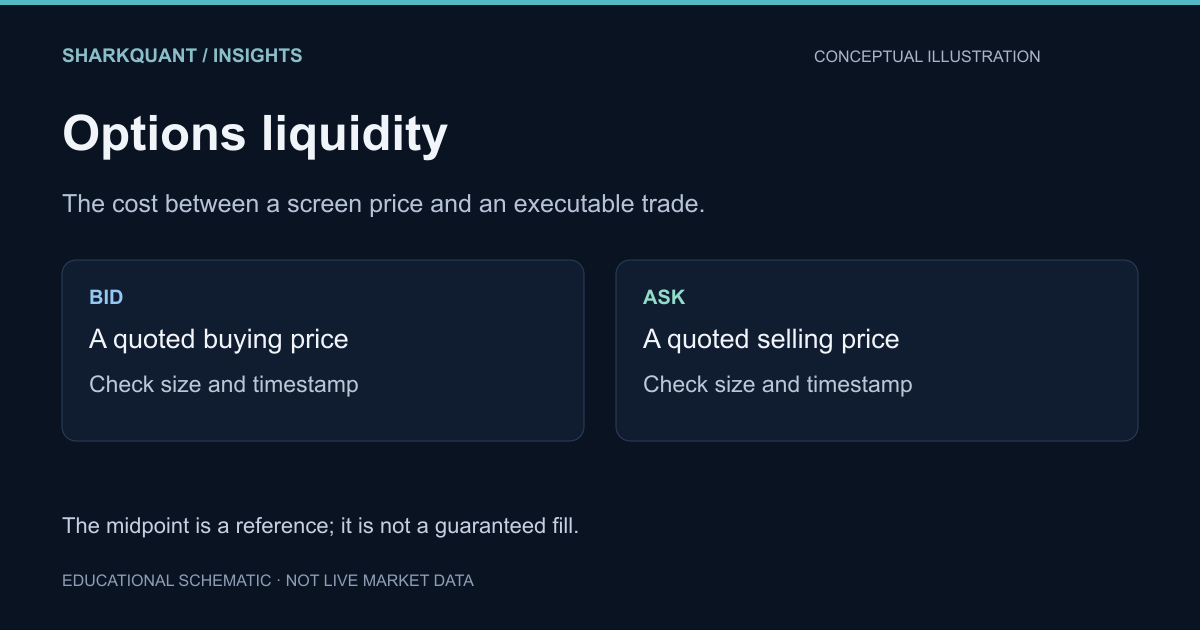
Liquidity gets described as if it were a vibe. In practice it has a number, or at least a first approximation: the bid-ask spread. Reading it before every order takes seconds, and it is one of the few trading costs you can measure in advance.
The bid is the highest price a buyer is currently willing to pay, and the ask is the lowest price a seller will accept. Liquidity, in the everyday sense, is how cheaply and quickly you can get in and out, and the width of the spread is its most visible measure.
Where the spread comes from
Consolidated exchange quotes provide the National Best Bid and Offer, or NBBO, shown on many option chains. Bid size reflects demand at that price; ask size reflects supply. When you buy at the ask and later sell at the bid, the difference is a cost you pay for trading now instead of waiting.
A hypothetical, rounded example: a contract quoted at $1.00 bid and $1.20 ask has a $0.20 spread, or $20 per contract at the standard $100 multiplier. A round trip on five contracts costs roughly $100 if nothing else changes. That arithmetic works on any quote you pull; the numbers here are illustrative, not current market data.
What makes a spread wide or narrow
OIC lists the usual factors: economic events, anticipated news such as earnings, perceived trading risk, and competition among market participants. Even the underlying's own spread can pull the option's spread wider.
Quote size matters alongside spread width. Exchange rules impose quotation obligations under specified conditions, but those obligations are not a promise that a displayed quote will remain available when your order arrives. Quotes can update or be canceled, depth can be small, and special market conditions can change trading rules. Read the current size rather than assuming that a tight spread guarantees a large fill.
The series itself matters as well. Deep out-of-the-money weeklies and far-dated strikes often trade wider than at-the-money monthlies, and everything tends to widen when the market moves fast. That is a tendency, not a law, but it is the right prior before you check the actual quotes.
Read the spread in context
Width in dollars can mislead; width as a percentage of the option's price compares more cleanly. Twenty cents is about 2% of a $10 option and about 20% of a $1 option. Check three things together: the width, the size standing at the bid and ask, and how recently the quote updated. Snapshots age. A quote that sat untouched through a fast move may not represent anything you can actually trade.
Then look at the exit before the entry. The market you will sell into later can be different from the one you buy from now, and that gap matters most for orders that convert into market orders under stress, like triggered stops, and for any position you may need to close in a hurry.
Execution choices that respect the cost
- Market orders prioritize prompt execution rather than a chosen price. In a wide or fast market they can fill badly, partially, or be delayed; a trading halt or lack of executable liquidity can prevent a fill.
- Limit orders set the worst acceptable execution price, but the order can remain unfilled.
- Slippage is the difference between an expected and actual fill. Wide spreads and limited depth can increase execution uncertainty.
Working an order patiently costs time. Paying the spread costs money. The right mix depends on how much the timing of the trade actually matters to your thesis.
A hypothetical comparison
Two contracts expressing the same hypothetical thesis. The liquid one quotes $2.00 bid and $2.05 ask, a nickel wide, about 2.5% of the midpoint. The thin one quotes $1.90 bid and $2.15 ask, a quarter wide, more than 12% of the midpoint. If you buy at the ask and immediately sell at the unchanged bid, three contracts lose $15 in the first market and $75 in the second, before fees. Midpoint fills would change that arithmetic. Both figures are hypothetical and rounded, and real fills vary, but the gap is the point: the same view can have very different costs depending on where it is expressed.
A tight spread still does not tell you why anyone is trading. That is a separate question, covered in options flow vs dealer positioning.
Checklist before you send an options order
- Check the spread in dollars and as a percentage of the option's price.
- Check quote sizes and the quote timestamp, especially after fast moves.
- Compare the contract you plan to exit into, not just the one you are entering.
- Choose market versus limit deliberately, and know what immediacy costs you.
- Size to the market. Large orders in thin series move prices against you.
- Pull volume and open interest for additional context before assuming a series trades like its neighbors (see open interest vs volume).
- Recheck everything at the moment of the trade. Quotes do not hold still.
Limitations
Spreads change by the second, and displayed quotes are snapshots of the moment they were published. Exchange quote rules set minimum obligations, not guarantees of depth, and none of this promises the price your order will receive. The examples here are illustrative, not quotes from any current market. New to the building blocks? The Learn section covers the foundations. Educational content only; nothing here is investment advice.
Sources and further reading
- OIC, Understanding the Bid and Ask Prices for Options
- OIC, General Information FAQ
- OIC, Trade Entry and Execution FAQ
- OIC, Open Interest: Why It Matters
- OCC, Index Options (contract multiplier and cash settlement background)
- Cboe, 0DTE Trading Resources
- FINRA, Options
Educational content only. Nothing here is investment advice or a personalized recommendation. Options involve risk and are not suitable for all investors, and you should review the Characteristics and Risks of Standardized Options before trading. Prepared with AI assistance; reference links were checked before publication.