
Options sweeps explained: what the prints tell you
A sweep shows urgency: an order crossing venues to take displayed quotes. It does not prove direction, conviction, or whether a position was opened or closed.
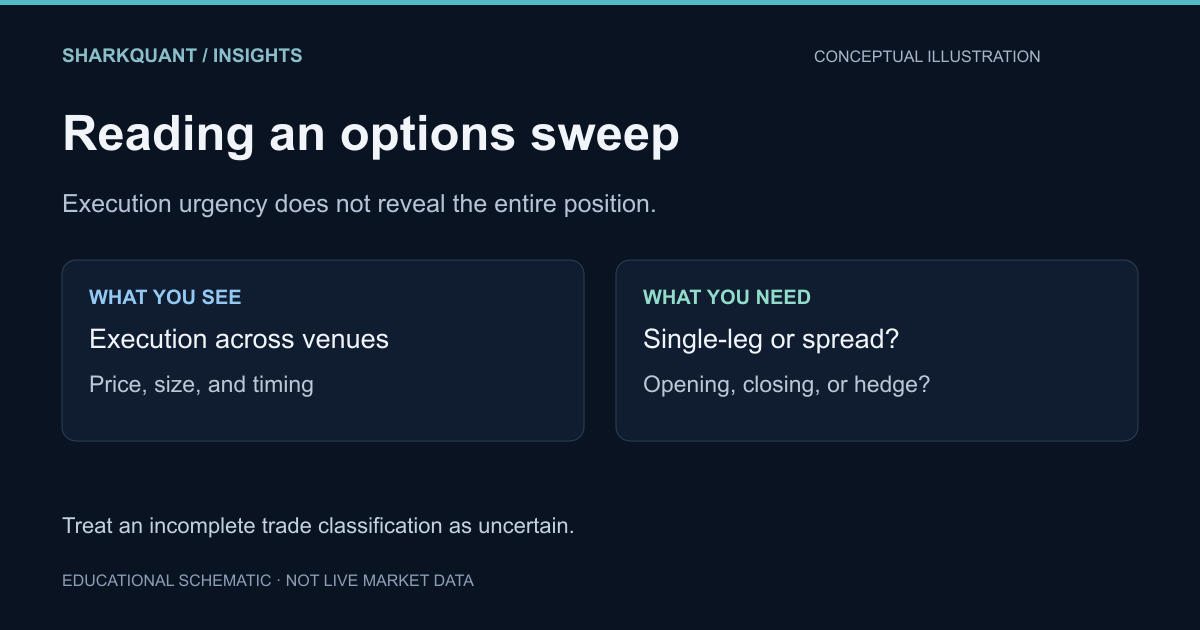
A sweep gets noticed because it looks decisive: one order, several exchanges, contracts changing hands in seconds. Feeds flag it, chats amplify it, and someone announces that big money just did something. The mechanics are real. The story attached to them usually is not.
An options sweep label usually describes a cluster of rapid executions across venues. It can suggest that displayed liquidity was taken quickly, but the classification method matters. A formal intermarket sweep order (ISO) is a specific limit-order instruction, with responsibility for addressing better-priced protected quotes. A scanner label and an exchange ISO designation are not interchangeable.
What a sweep demonstrates is how an order was executed. It is not, by itself, a statement about direction, conviction, or whether anyone opened a position.
What the rules actually say
The ISO definition lives in exchange rulebooks. In the Nasdaq ISE rulebook, as amended in a 2023 filing published in the Federal Register, an ISO is a limit order that trades at allowable prices without regard to the best displayed price on any single exchange. Simultaneously with the routing of the ISO, one or more additional orders are routed to execute against the full displayed size of any protected bid, in the case of a sell order, or protected offer, in the case of a buy order, for the series at a price that is better than the ISO's limit price.
In plain terms, the router can access liquidity promptly while sending the necessary orders for better-priced protected quotes. The ISO still has a limit price. It is not permission to buy at any price, a requirement to visit every venue, or evidence of a bullish investment thesis.
What a sweep does not tell you
Whether a position was opened or closed
Option orders carry a to-open or to-close designation, and open interest is calculated by OCC from the reports exchanges consolidate. The raw print announces neither. The gap is telling: Cboe publishes a purpose-built dataset, the Open-Close Volume Summary, that categorizes every trade by participant type, buy or sell action, and open or close position. When reconstructing that information takes a dedicated data product, it is a good sign you should not read it off a single print.
Whether the order stood alone or was one leg
Cboe's own review of SPX same-day options activity found that roughly half of the volume came through spread structures, and even the single-leg share includes investors adjusting existing spread legs. A sweep in one strike may be one leg of a vertical, a calendar, or a hedge. The print shows one execution of one leg, not the shape of the trade.
Who is on the other side, and why
Market makers exist to take the opposite side of customer flow, post quotes across many strikes, and hedge the resulting position to stay close to market neutral. The liquidity a sweep consumes may be a dealer's quote, not a statement. Even when a data product labels the aggressor side, the label describes the execution, not the participant's view.
A hypothetical sweep, read carefully
Suppose a scanner groups a hypothetical 3,200 weekly index calls printed across four venues within two seconds, near the offers visible at those times. That is consistent with aggressive liquidity-taking. It does not prove that the prints shared a single parent order, that quotes were synchronized, or that the contracts opened a new directional position. The cluster could be part of a roll or spread, and the aggressor classification can be wrong if a quote is stale. The size and timing are observations; participant identity and motive remain inferences.
How to use sweep information without overreading it
Start with timestamps. A sweep's meaning depends on when it happened relative to the session, the quote, and any news, and untimestamped data ages badly. Then look at the neighborhood: did other strikes or the underlying trade at the same moment? A single series moving alone is a different observation from a strike ladder or a paired trade.
Follow up with open interest over the next day or two for context. Rising open interest corroborates that positions are building (see open interest vs volume), but it still does not say who or why. And keep sweeps in proportion with everything else you watch. If you track flow at all, sweeps are one ingredient among several, alongside price structure and the dealer positioning picture described in options flow vs dealer positioning. The options flow section is the place to start if you are new to that kind of reading.
Checklist when you see a sweep
- Note the exact time, series, venues, size, and price relative to the quote at that moment. Data without timestamps is trivia.
- Record what else traded nearby: other strikes, other expirations, the underlying.
- Ask for the boring explanation first. Consider a spread leg, hedge, roll, or closing trade before assuming a fresh directional bet.
- Follow up with open interest and volume data as it updates, and be honest about how much it can corroborate.
- Write down what would have to be true for the sweep to mean what you think it means. If nothing observable distinguishes signal from noise, downgrade the read.
Limitations
ISO mechanics come from exchange rules, and venues implement the details differently. Derived datasets vary in coverage, and every data product has its own reporting conventions. Sweeps are not meaningless: they are genuine evidence of urgency and size taken. The limits here are about inference, not about the data. Educational content only; nothing here is investment advice.
Sources and further reading
- Federal Register, Self-Regulatory Organizations; Nasdaq ISE, LLC, filing on ISO functionality (intermarket sweep order definition)
- Cboe DataShop, Open-Close Volume Summary
- Cboe, The Evolution of Same Day Options Trading
- OIC, Open Interest: Why It Matters
- OIC, July Office Hours FAQs: Implied Volatility, Position Greeks and Market Maker Order Flow
- Cboe, 0DTE Trading Resources
- FINRA, Options
Educational content only. Nothing here is investment advice or a personalized recommendation. Options involve risk and are not suitable for all investors, and you should review the Characteristics and Risks of Standardized Options before trading. Prepared with AI assistance; reference links were checked before publication.