
Gamma squeeze vs. short squeeze: how to tell them apart
Gamma squeezes and short squeezes get used as synonyms, but the mechanics and the evidence are different. How to tell which story the data supports.
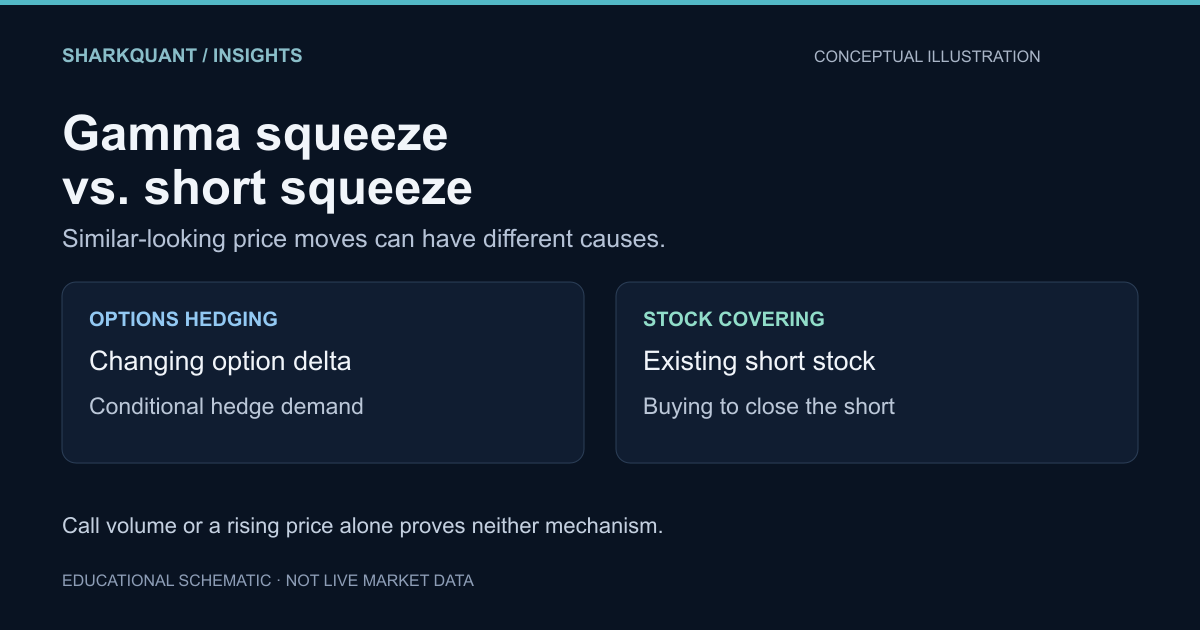
"Squeeze" gets attached to any fast rally in a heavily shorted or options-heavy name, and the two labels get treated as interchangeable. They are not. A short squeeze runs through stock borrowing. A gamma squeeze runs through options hedging. They leave different evidence and carry different risks.
A short squeeze is a rally amplified by short sellers buying stock to close their positions. A gamma squeeze is a rally amplified by hedge buying from participants with short-gamma options exposure, often discussed in connection with dealers short calls. Both mechanisms are conditional, can overlap, and can unwind. A fast rally alone proves neither.
The short squeeze mechanism
The SEC's staff report on the January 2021 meme stock episode describes the short squeeze mechanism: an event pushes a heavily shorted stock's price up, margin calls follow, and short sellers must post collateral or buy shares to close. That covering is buying pressure, which can push price higher, which can force more covering (SEC staff report, Section 3.4).
High reported short interest and a scarce or expensive stock borrow can make a squeeze hypothesis worth investigating. They do not establish that covering caused a particular rally. Reported short interest is a stock of open positions; it is not the daily volume of short sales. A ratio also needs a stated denominator, such as shares outstanding or tradable float.
Short sellers face losses that are theoretically unlimited, because a stock can keep rising (SEC investor bulletin, short sales). Late buyers face the opposite risk: covering stops when the shorts are out, and the buying pressure that carried the rally leaves with it.
The gamma squeeze mechanism
The SEC staff report describes a gamma squeeze as hedge purchases associated with writing call options that add upward pressure to the stock. If dealers are net short gamma, a rising stock can increase the long-stock hedge needed to offset their option delta. Additional buying can reinforce the move. That requires the assumed positions and actual hedge adjustments; a burst of call volume does not establish either.
Nobody needs to be short a single share for this to work. The vulnerable structure is a heavy concentration of call open interest near the money in the front expiration, combined with dealers modeled as short those calls. And that setup depends on an estimate: public data does not report who holds those contracts, so "dealers are short those calls" is an ownership inference, not a fact (Options flow vs. dealer positioning).
The evidence is different, and that is the point
To claim a short squeeze, the evidence lives in borrow data and reported short interest: the latest reported figure, its trend across reports, and the cost to borrow. All of it is aggregate and delayed. FINRA requires member firms to report short positions twice a month, due by the second business day after the settlement date, and publishes compiled figures about the seventh business day after settlement (FINRA equity short interest). Fails to deliver get cited too, though the SEC cautions that they occur with long and short sales alike, making them imperfect measures.
For its October 14, 2021 study of GameStop trading, SEC staff examined whether option buying was concentrated in calls and whether market makers were writing the calls. Staff reported that the increase in trading was driven primarily by puts and that market makers were buying rather than writing calls. The report states: "These observations by themselves are not consistent with a gamma squeeze." That finding is specific to the episode and evidence the staff studied.
The staff also found that short covering alone did not explain the sustained run-up. The lesson is methodological: test the ownership and flow story instead of selecting a squeeze label because it matches the price chart. These are staff findings, not a rule or statement approved by the SEC Commission.
A hypothetical walk-through
Imagine a hypothetical company, HYPX, trading at $40, with reported short interest equal to 30% of its float, a borrow fee that has climbed from 2% to 40%, and a large cluster of call open interest at the $45 strike in the front expiration.
A later drop in reported short interest is consistent with net covering, but new short positions can offset closed ones, and a delayed report cannot locate covering within a specific minute. The gamma hypothesis needs separate evidence about opening and closing options activity and plausible dealer exposure. If the hypothetical $45 calls are mainly closing trades, the argument for newly created short-call hedging is weaker. Buying pressure also need not keep accelerating above a strike: call delta approaches a limit as the option moves deep into the money. HYPX is invented; no live data is described.
A practical checklist for telling them apart
- Start with the borrow side: reported short interest level and trend, remembering that position reports are periodic. Borrow rates may change more frequently.
- Move to the options side: is activity call-heavy or put-heavy, and is it opening or closing where the data can say? Aggressive buying that crosses the spread in size is one clue (Options sweeps explained).
- Ask who is presumed short the calls. Without that ownership assumption there is no gamma squeeze mechanism, only call buying.
- Track where price sits relative to the heaviest call cluster, where mechanical pressure concentrates if the estimate is right (What a wall is).
- Look for evidence specific to the proposed mechanism and record competing explanations. Agreement between two incomplete measures is not proof of causation.
- Covering exhausts itself, and hedging reverses as positions roll or close. The machinery that amplified the rally can amplify the decline.
Limitations
- Squeeze diagnoses are retrospective. During a move, the data is partial and delayed, and both labels invite motivated reading.
- Reported short interest is aggregate, arrives twice a month, and can exceed 100% mechanically.
- Options open interest and flow do not reveal ownership. Dealer positioning in options is estimated, never reported.
- Even a well-built mechanical story is not a forecast. In the January 2021 episode studied by SEC staff, those mechanisms did not explain the sustained run-up on their own (Why every read names invalidations).
- Nothing here is a method for trading squeezes. Reflexive, crowded moves carry gap risk and liquidity risk in both directions.
Sources and further reading
- SEC staff report, Equity and Options Market Structure Conditions in Early 2021
- Archived copy of the same SEC staff report
- FINRA, About Equity Short Interest
- SEC, Investor Bulletin: An Introduction to Short Sales
- Options Industry Council, Gamma
Educational content only. This is not personalized investment advice and not a recommendation to buy or sell any security. Options involve risk and are not suitable for every investor.
Prepared with AI assistance; reference links were checked before publication.